M1 / Semestre 7 – Bloc 1 (Majeure) – B. Enjeux et pratiques disciplinaires
UE2 : Enjeux contemporains (Cultural Studies) - Cours de D. Haigron
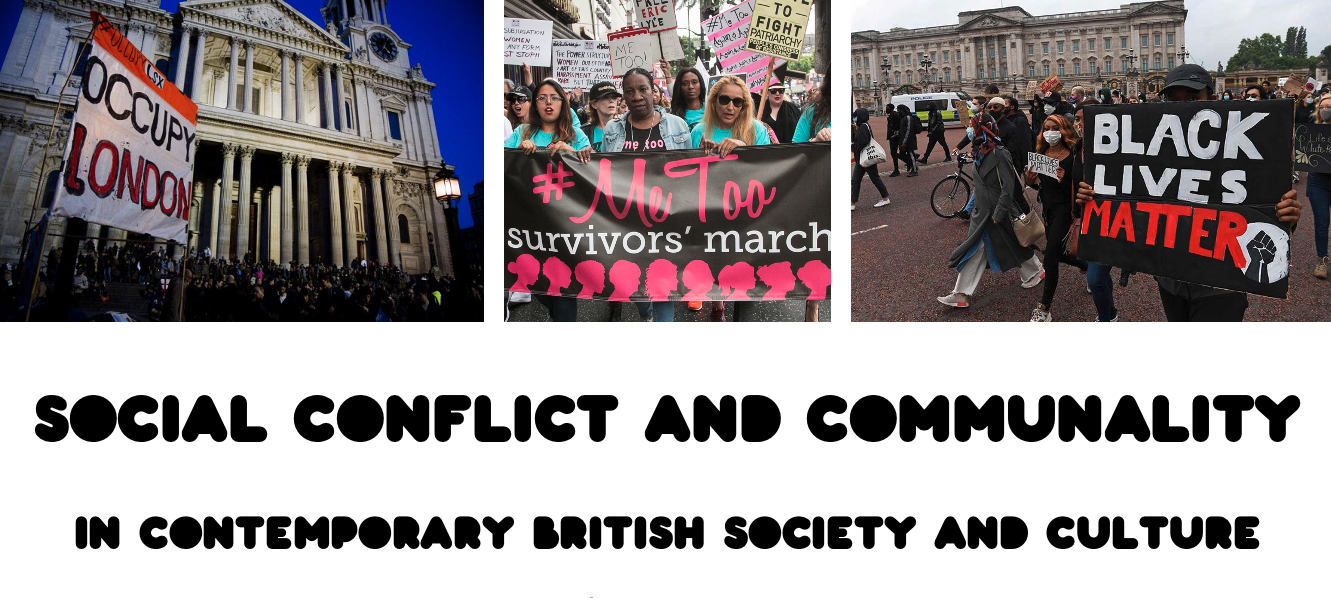
Social conflict and communality: Class, gender, and race in contemporary British society and culture
British society is built on structural divisions based (mostly but not entirely) on class, gender and race, and its construction is driven by conflicts between categories of the population defending their respective interests in power relations, usually with an opposition between discriminated minorities and an hegemonic group. These conflicts have contributed to fostering communitarian identities and histories (Orgreave, Dagenham, #MeToo, Black Lives Matter, etc.), but have also found their place in collective national memory. This course will analyse social conflicts from a sociological and cultural perspective. The aim is to assess how they gained mythological status as defining landmarks, and how they participated in shaping British society. This will finally raise the question as to whether social conflict also —somehow paradoxically— helped build togetherness and communality, within or between the various sections of society.
Selected bibliography
BANYARD, Kat. The Equality Illusion: The Truth about Women and Men Today. Faber & Faber, 2010.
CANNADINE, David. The Undivided Past: Humanity Beyond our Differences. Alfred A. Knopf, 2013.
GILROY, Paul. There Ain’t No Black in the Union Jack: The Cultural Politics of Race and Nation. Routledge (1987), 2010.
HALL, Stuart, et al., eds. Representation. Sage & Open University, 2013.
JONES, Owen. Chavs: The Demonization of the Working Class. Verso, 2016.
PANAYI, Panikos. An Immigration History of Britain: Multicultural Racism since 1800. Longman, 2010.
SKEGGS, Beverley. Formations of Class and Gender: Becoming Respectable. Sage, 1997.
UE2 : Enjeux contemporains (Cultural Studies) - Cours de D. Haigron
Social conflict and communality: Class, gender, and race in contemporary British society and culture
British society is built on structural divisions based (mostly but not entirely) on class, gender and race, and its construction is driven by conflicts between categories of the population defending their respective interests in power relations, usually with an opposition between discriminated minorities and an hegemonic group. These conflicts have contributed to fostering communitarian identities and histories (Orgreave, Dagenham, #MeToo, Black Lives Matter, etc.), but have also found their place in collective national memory. This course will analyse social conflicts from a sociological and cultural perspective. The aim is to assess how they gained mythological status as defining landmarks, and how they participated in shaping British society. This will finally raise the question as to whether social conflict also —somehow paradoxically— helped build togetherness and communality, within or between the various sections of society.
Selected bibliography
BANYARD, Kat. The Equality Illusion: The Truth about Women and Men Today. Faber & Faber, 2010.
CANNADINE, David. The Undivided Past: Humanity Beyond our Differences. Alfred A. Knopf, 2013.
GILROY, Paul. There Ain’t No Black in the Union Jack: The Cultural Politics of Race and Nation. Routledge (1987), 2010.
HALL, Stuart, et al., eds. Representation. Sage & Open University, 2013.
JONES, Owen. Chavs: The Demonization of the Working Class. Verso, 2016.
PANAYI, Panikos. An Immigration History of Britain: Multicultural Racism since 1800. Longman, 2010.
SKEGGS, Beverley. Formations of Class and Gender: Becoming Respectable. Sage, 1997.
- Docente: David Haigron

Ce séminaire sera consacré à l’analyse linguistique à partir d’un corpus de séries télévisées. Le séminaire de 2026-2027, assuré par Sandrine Oriez, est axé sur la syntaxe de la phrase anglaise. Ce séminaire permet aux étudiants qui le souhaitent d'acquérir des connaissances en syntaxe indispensables pour passer les concours du CAPES et de l'agrégation.
Si vous êtes débutant.e en syntaxe (cf. étudiant.e ayant fait une Licence hors Rennes 2), pas d'inquiétude : le cours est structuré de manière à réviser/acquérir rapidement les bases de la syntaxe. Des pages de révision et des vidéos de révision sont disponibles sur la page du séminaire.
Le cours est en FRANCAIS.
Les agrégatives et agrégatifs peuvent le suivre.
Si vous êtes débutant.e en syntaxe (cf. étudiant.e ayant fait une Licence hors Rennes 2), pas d'inquiétude : le cours est structuré de manière à réviser/acquérir rapidement les bases de la syntaxe. Des pages de révision et des vidéos de révision sont disponibles sur la page du séminaire.
Le cours est en FRANCAIS.
Les agrégatives et agrégatifs peuvent le suivre.
- Docente: Anne-Laure Besnard
- Docente: Sandrine Oriez
- Docente: Manon Philippe
Cet espace cours vous donne accès à des ressources complémentaires.
Chaque enseignant·e pourra y déposer des documents.
Chaque enseignant·e pourra y déposer des documents.
- Docente: Sylvie Bauer
- Docente: Anne-Laure Besnard
- Docente: Claire Bonnel
- Docente: Stephanie Croizet
- Docente: Tatiana Gafanhao
- Docente: Anne Goarzin
- Docente: David Haigron
- Docente: Anais Le Fevre-Berthelot
- Docente: Helene Machinal
- Docente: Grainne O'Keeffe Vigneron
- Docente: Sandrine Oriez
- Docente: Manon Philippe
- Docente: Isabelle Picault
- Docente: Lucie Ribourg
- Docente non editor: Yann Bevant
- Docente non editor: Aurore Caignet
- Docente non editor: Valerie Capdeville
- Docente non editor: Nicole Cloarec
- Docente non editor: Anita Cornic
- Docente non editor: Emilie Dardenne
- Docente non editor: Claudia Desblaches
- Docente non editor: Renee Dickason
- Docente non editor: Maggy Hary-Moussay
- Docente non editor: Jean Pierre Juhel
- Docente non editor: Anthony Larson
- Docente non editor: Pierre-Yves Le Cam
- Docente non editor: Claude Le Fustec
- Docente non editor: Gildas Le Voguer
- Docente non editor: Lesley Lelourec
- Docente non editor: Delphine Lemonnier-Texier
- Docente non editor: Mark Mcnaught
- Docente non editor: Sophie Mesplede
- Docente non editor: Adrian Morfee
- Docente non editor: Francoise Remond
- Docente non editor: Emma Renaud
- Docente non editor: Johanna Sauvage
- Docente non editor: Maria Tang
- Docente non editor: Florian Treguer
- Docente non editor: Aliette Ventejoux

- Docente: Valerie Capdeville
- Docente: Anais Le Fevre-Berthelot
- Docente non editor: Franck Barbin
- Docente non editor: Sylvie Bauer
- Docente non editor: Laurie Bereau
- Docente non editor: Anne-Laure Besnard
- Docente non editor: Yann Bevant
- Docente non editor: Aurore Caignet
- Docente non editor: Anita Cornic
- Docente non editor: Claudia Desblaches
- Docente non editor: Laetitia Devos
- Docente non editor: Renee Dickason
- Docente non editor: Anne Goarzin
- Docente non editor: David Haigron
- Docente non editor: Maggy Hary-Moussay
- Docente non editor: Jean Pierre Juhel
- Docente non editor: Anthony Larson
- Docente non editor: Pierre-Yves Le Cam
- Docente non editor: Claude Le Fustec
- Docente non editor: Gildas Le Voguer
- Docente non editor: Lesley Lelourec
- Docente non editor: Delphine Lemonnier-Texier
- Docente non editor: Helene Machinal
- Docente non editor: Mark Mcnaught
- Docente non editor: Sophie Mesplede
- Docente non editor: Adrian Morfee
- Docente non editor: Grainne O'Keeffe Vigneron
- Docente non editor: Sandrine Oriez
- Docente non editor: Manon Philippe
- Docente non editor: Francoise Remond
- Docente non editor: Emma Renaud
- Docente non editor: Maria Tang
- Docente non editor: Donia Touihri-Mebarek
- Docente non editor: Florian Treguer
- Docente non editor: Aliette Ventejoux
- Docente: Florian Treguer

- Docente: Anais Le Fevre-Berthelot